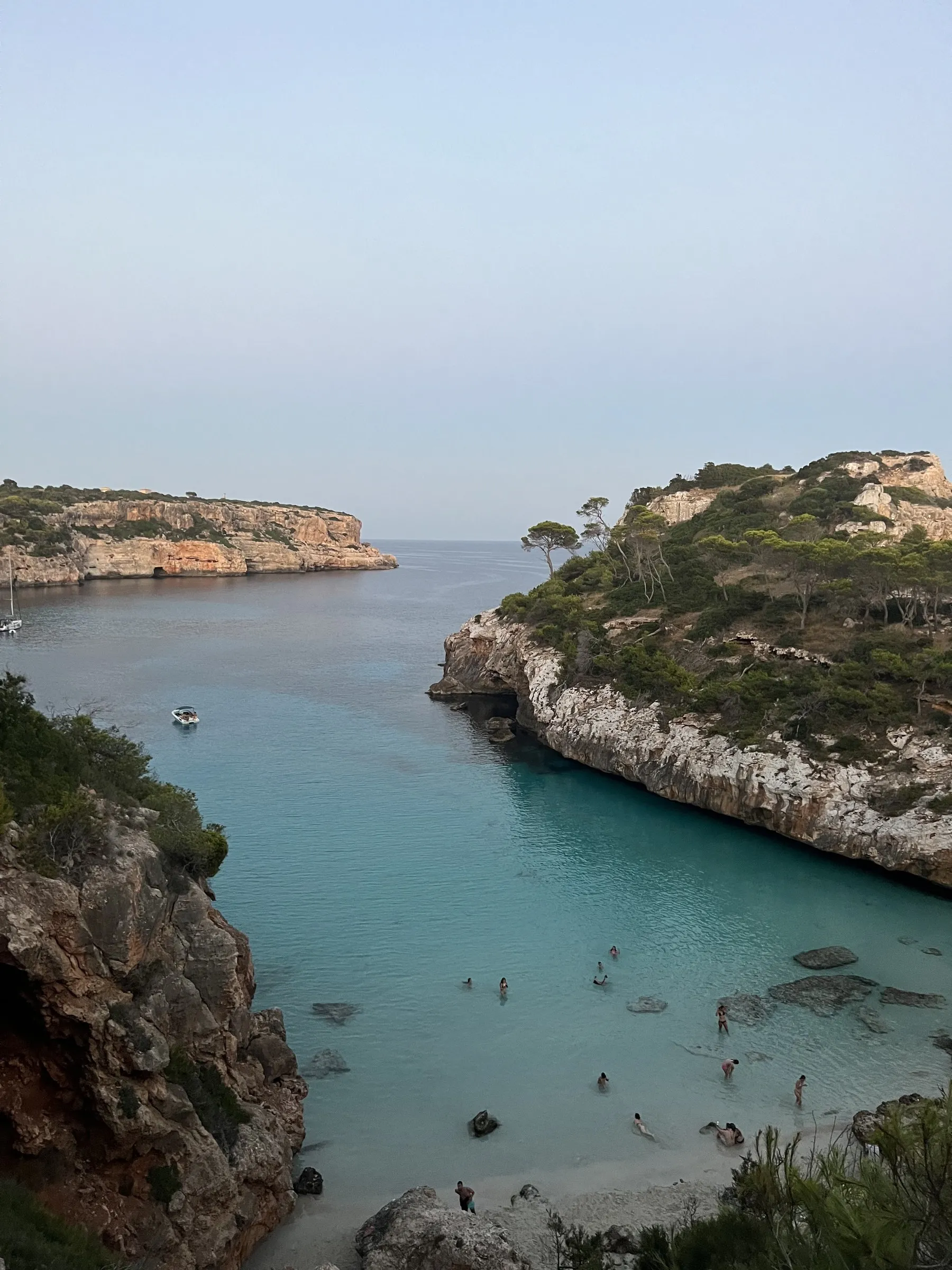
Caló des Moro and Cala s'Almunia: parking and timing
A 30-metre beach that draws up to 4,000 people a day. Where you actually park, what is regulated, and what time of day is worth it.
Caló des Moro is a tongue of sand a few dozen metres long, wedged between two cliffs. That is exactly why it is everywhere: the photograph is perfect and the place is tiny. Those two facts together are the problem.
Next door, five minutes on foot, is Cala s’Almunia: no sand, but stone boathouses — escars — and steps cut into the rock down to the water. You visit them together, and both are worth understanding before you go.
The numbers behind the restrictions
In May 2026 the local press reported the figures from the information panels installed on site:
- At peak times up to 4,000 people a day have converged on it.
- In high season an estimated 70 kilos of sand disappear daily: around 490 a week, two tonnes a month, six tonnes across the three high-season months.
That sand leaves, essentially, stuck to people. Which is why there is a brush there to clean your feet before you climb back up: not an eccentricity, a conservation measure.
There is a foundation, Amics d’es Caló des Moro–s’Almonia, working on preserving the area.
What is regulated, and what we could not confirm
Precision matters here, because a lot of out-of-date and mixed-up information circulates online.
What Santanyí town council does publish: a notice closing vehicle access to Cala s’Almunia to non-residents from 1 June — “Només podran accedir-hi els veïnats del municipi santanyiner” — stating that visitors can use the free car park at the entrance to Cala Llombards, and that from there it is about a kilometre and a half on foot, with no shuttle bus.
The important caveat: that notice mentions the changes caused by the COVID-19 pandemic, so it dates from 2020. We could not find an updated version on the council’s site confirming it still stands as written. For 2026 the press reports that the council has opened extra parking spaces at es Llombards and regulated access to the area — but without a published bylaw we could link to.
In practical terms: assume you will not park next to it, expect to walk, and follow the signs on the day. Anyone who tells you an exact rule with total confidence does not know either.
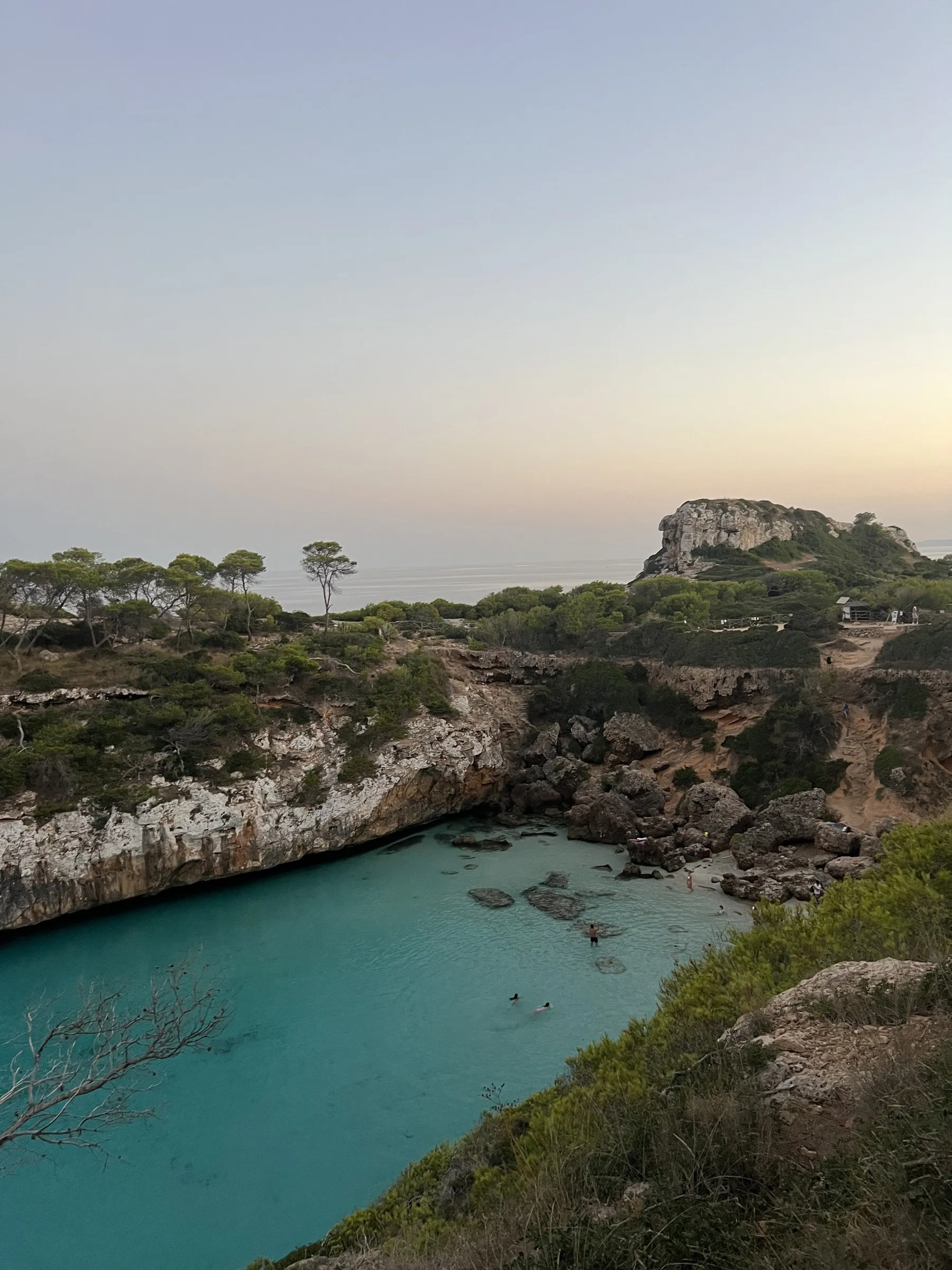
Cala s’Almunia on 21 August 2023, with the sun already low.
What nobody tells you about the descent
- There are no facilities. No bar, no toilets, no showers, no shade on the sand. Nothing.
- The way down is a rock staircase, uneven and without a handrail for much of it. Flip-flops are a bad idea, and so are small children or bad knees.
- Caló des Moro holds as many people as it holds. At midday in August there is no room to lay a towel; you stand, or you sit on the rocks.
- S’Almunia has no sand at all. You get in from the rock and from the steps beside the boathouses. The water is just as good and the shore far less crowded — comfortable it is not.
What time to go
Our photograph was taken at a quarter to nine in the evening on 21 August, and you can see the difference: there are people, but there is room.
- Very early, before nine or ten in the morning, and late afternoon are the two windows that work in summer.
- Out of season it is a different place. The water stays clear, the light is better, and the parking problem disappears.
- Avoid midday in July and August. This is not a matter of taste: with up to 4,000 people a day, at that hour you will not see what you came to see.
How it fits with the rest of the south-east
If you are spending the day in the area, Mondragó Nature Park is a quarter of an hour away and does have regulated parking, plenty of sand and facilities. And if you want coastline with nobody on it, Cap de ses Salines is half an hour south — no bar and no shade, but no queue either.
More photos
-
Cala s'Almunia · 21 Aug 2023
-
Cala s'Almunia · 21 Aug 2023
-
Cala s'Almunia · 21 Aug 2023